
The data exists. Most institutions collect it annually. Alumni surveys, first-destination reports, employer feedback. The information families are looking for is sitting in institutional research databases, reported to accreditors, and summarized in annual reports that almost no one reads.
The problem is not that higher education doesn't know where its graduates go. The problem is that this information doesn't reach the families who need it to make confident enrollment and re-enrollment decisions.
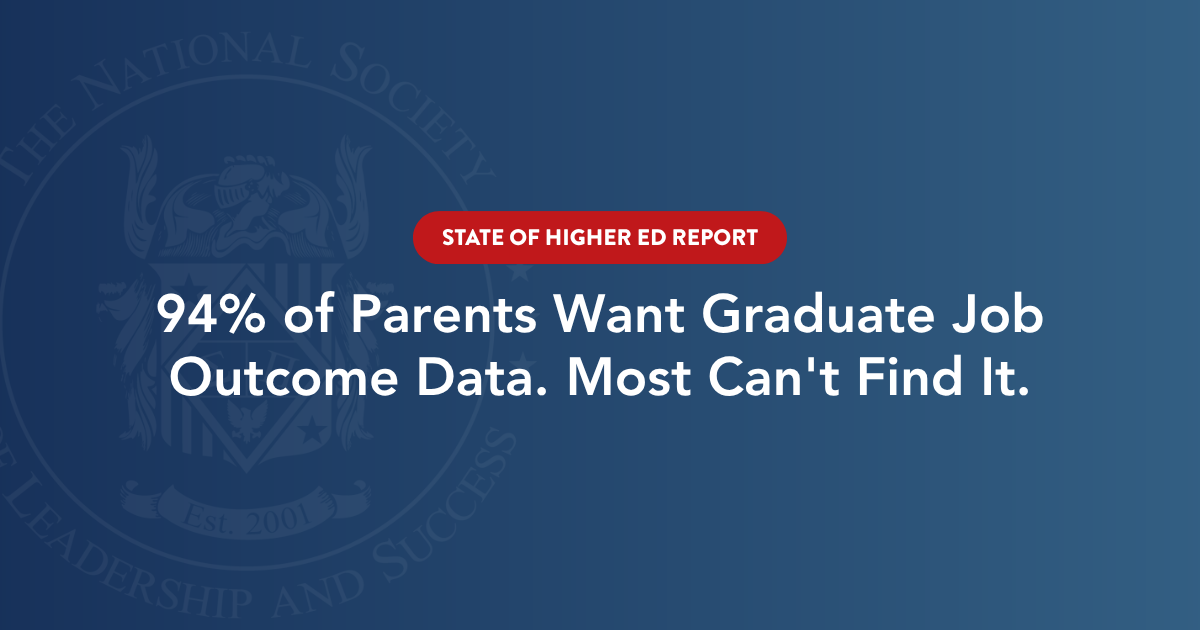
According to the 2026 State of Higher Ed Report, 94% of parents say graduate job outcomes are essential information for evaluating whether college is worth the cost. Sixty-eight percent say they can't find it. That gap between what families need and what they can access is not a data problem. It's a communication problem. And it's costing institutions enrollment, family confidence, and long-term alumni relationships.
What Families Are Actually Looking For
The "job outcomes data" families want is more specific than the aggregate employment statistics many institutions publish. When a parent asks "where do your graduates go?", they're typically asking a layered question.
What do graduates in my student's intended major actually do? Generic employment-rate figures are minimally useful to a family evaluating a specific degree in a specific field. What's useful is knowing which sectors a program's graduates actually work in and what the median starting salary looks like for that specific track.
What are realistic salary expectations? Families who are weighing six-figure debt against future earnings need specific salary data by major, career track, and geography, not lifetime earnings estimates or averages that obscure significant variation.
What does the career trajectory look like? First-destination data shows where graduates land. Career trajectory data shows where they go after that. Families who can see that graduates in a specific program are building toward stable, growing career paths have a different confidence level than families who can only see where the first job was.
Are the outcomes consistent, or exceptional cases? A single success story is not data. Families who've read enough admissions marketing can identify when an institution is leading with its best outcomes rather than its typical ones. Specific, honest, comprehensive data is more credible than curated highlights, and more useful.
Why the Data Gap Exists
Institutions collect outcome data. They don't always prioritize communicating it. Several factors contribute to the gap.
Institutional structure is one: the offices that collect outcome data (institutional research, career services, alumni affairs) and the offices that communicate with prospective and current families (admissions, marketing) often operate without strong coordination. Data collected for accreditation purposes doesn't automatically become marketing content.
Fear of unfavorable comparison plays a role too. Institutions whose outcome data is below peer benchmarks have incentives to make that data harder to find rather than more accessible. This calculus is shortsighted, since the 68% who can't find the data assume the worst, and that assumption is often more damaging than honest disclosure would be, but it's a real factor in institutional communication decisions.
Format and accessibility failures compound the problem. Even when outcome data exists on institutional websites, it's often buried in PDF reports, formatted for accreditors rather than families, and described in language that requires interpretation to apply to a specific major and career path. Technically available is not the same as practically accessible.
And outdated data timelines don't help. Outcome data collected through annual first-destination surveys is often one to three years old by the time it's published. In a labor market that changes significantly year to year, older data may not adequately represent current graduate outcomes.
The Competitive Cost of the Information Gap
The 68% who can't find outcome data are not searching in obscure places. They're looking where families naturally look: institutional websites, conversations with admissions staff, enrollment materials. The absence of accessible, specific outcome data in those channels communicates something; either that the institution doesn't have the data, doesn't think it matters, or doesn't want families to find it.
None of those impressions builds confidence. And in an environment where family satisfaction with college ROI dropped 18 points in a single year according to the State of Higher Ed Report, the institutions that proactively close this information gap have a specific competitive advantage.
An institution that can clearly show what its marketing graduates earn in their first job, where they're working at five years, and the range of outcomes across its programs is demonstrating exactly the transparency families are asking for. In enrollment conversations where a family is weighing options, that transparency differentiates.
The institutions that close the gap first will attract the families who are actively seeking evidence. The ones that wait will continue losing those families to institutions, and alternatives, that can make the case more clearly.
What Better Outcome Communication Looks Like
The infrastructure for better outcome communication exists in most institutions. What's needed is intentional application of that infrastructure to family communication.
Every academic program page should include major-specific outcome data for graduates in that program: employment rate, top employer partners, median starting salary, and career trajectory data, updated annually and presented in family-friendly language rather than accreditation report format. The most engaging outcome communication uses interactive tools that allow families to filter by major, career track, geography, and graduation year; several institutions have already built these, and the pattern is replicable with accessible technology.
Outcome data belongs in enrollment conversations directly. Admissions staff who can speak specifically about graduate outcomes in a family's area of interest close the information gap in the highest-stakes decision moment, which makes equipping admissions counselors with major-specific outcome data a training and materials investment with direct enrollment impact.
Transparent reporting on the full range of outcomes matters more than curated highlights. Median outcomes are more trustworthy than highlighted outcomes. Institutions that report the full distribution, including where outcomes are weaker, build more credibility than institutions that selectively highlight success stories. Families can usually tell the difference, and the impression left by curated highlights is often less favorable than honest comprehensive data.
Frequently Asked Questions
What's the risk of publishing unfavorable outcome data?
Less than the risk of not publishing data at all. The 68% who can't find outcome data assume the worst; they're not assuming the best in the absence of information. Institutions with below-benchmark outcomes that publish honest data, contextualized with explanation of what they're doing to improve, typically build more family confidence than institutions that keep the data inaccessible.
How should institutions handle outcome data in fields with highly variable outcomes?
Variable outcomes should be communicated as variable outcomes, with context about what factors drive the variation. A program where median outcomes are strong but outliers exist on both ends is better communicated by describing the typical role and salary alongside where outcomes are strongest and where they're more variable, rather than reducing it to a single average or a single highlight.
How often should outcome data be updated?
Annually at minimum. Institutions that update first-destination data on a two to three year cycle are publishing increasingly outdated information. The labor market shifts significantly within that period, and families making current enrollment decisions need current data.
What if career services doesn't currently collect outcome data systematically?
Building systematic outcome tracking is a medium-term investment, but it starts with small steps: first-destination surveys, LinkedIn alumni tracking, and employer feedback systems. The investment pays back in accreditation value, enrollment differentiation, and the institutional knowledge needed to design programs that produce the outcomes families are looking for.
The information families need to make confident enrollment decisions is mostly in institutional databases. The gap is distribution, not collection. The institutions that close that gap proactively will earn back the confidence that the 68% are currently withholding. For the full data on family expectations, outcome transparency, and what drives college ROI confidence, read the 2026 State of Higher Ed Report.