
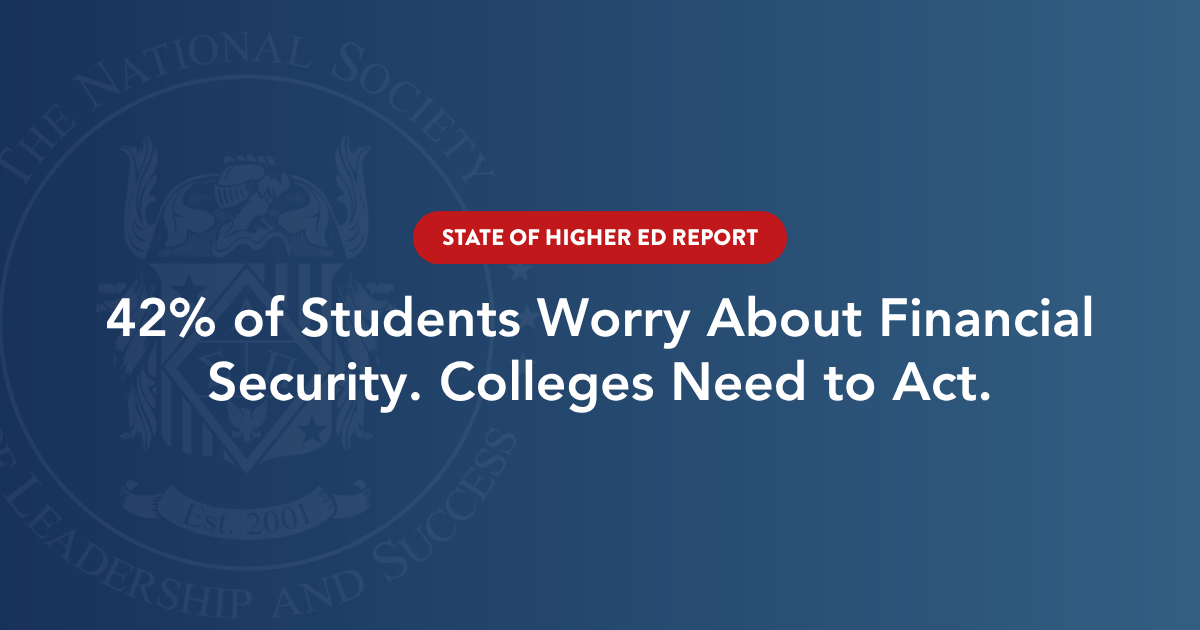
Nearly half of college students are worried about their financial future. According to the 2026 State of Higher Ed Report, 42% of students say they worry about their future financial security, and 59% have considered dropping out because of financial stress.
Institutions know this. According to the same report, 100% of administrators acknowledge that their students worry about financial stability. The awareness is universal and the data is clear. What's less clear is why these two conversations, financial anxiety and career readiness, so rarely happen together.
They're the same conversation.
Why Financial Anxiety and Career Uncertainty Belong Together
Financial anxiety in college students is almost never purely about the present cost of school. It's about the uncertainty of what comes after. Students who are worried about money aren't just worried about paying this semester's bills; they're worried about whether their degree will position them for economic stability, whether they'll be able to afford housing, and whether the investment they're making now will pay off.
According to the 2026 State of Higher Ed Report, 35% of students worry they'll never own a home. Thirty-four percent say starting a career scares them. These aren't worries about tuition; they're worries about trajectories. About what life will look like after graduation.
That means financial anxiety is, in significant part, a career uncertainty problem. Students who have a clear sense of where their degree is taking them, who can see a plausible professional direction and understand what that direction pays, experience the present cost of college differently than students who are investing in uncertainty. When the outcome is visible, the investment makes sense. When the outcome is opaque, every tuition payment feels like a gamble.
Career preparation doesn't just improve employment outcomes. It reduces financial anxiety by making the investment legible.
The Institutional Separation That Creates the Gap
Most colleges address financial anxiety through financial aid and counseling services. They address career uncertainty through career services offices, typically engaged late in the student journey. These are separate offices, separate workflows, separate conversations.
The separation is understandable. It reflects how institutions grew organizationally. But from a student perspective, the two concerns are deeply linked. A student who is worried about money and a student who is worried about career prospects are often the same student, and the most effective intervention addresses both at once.
According to the report, only 57.9% of administrators say their school is adequately preparing students for financial stability after graduation. Only 63.6% of students agree. That gap, between what institutions believe they're providing and what students feel they're receiving, lives in the space between financial support and career preparation.
Amy Everson, Sr. Director University Recognition & Institutional Events, at American Military University and American Public University, part of American Public University System, named the interconnection in the State of Higher Ed webinar, explaining how students who are financially constrained miss experiential learning opportunities (internships, leadership programs, extended enrollment) that would directly address their career readiness. The financial barrier and the career readiness gap reinforce each other. Treating them separately means treating each only partially.
What Integration Actually Looks Like
Addressing financial anxiety through a career readiness lens doesn't require reorganizing institutional structures. It requires a few specific changes in how existing resources are positioned.
First-year career conversations matter most. When career readiness programming starts in the first year, connected to academic advising and integrated into orientation, students develop professional direction earlier. Earlier direction reduces the ambient uncertainty that makes financial anxiety most acute.
Financial outcome data belongs in career advising too. Career services advising that includes concrete salary data, career trajectory information, and real-world financial outcome projections gives financially anxious students the evidence they need to make the investment feel rational. This data exists; making it accessible in advising conversations is a delivery challenge, not a data challenge.
Co-curricular programming that doesn't require financial flexibility helps close the gap further. Structured leadership and professional development programs that are embedded in the institution, accessible without additional cost or time outside of work obligations, reach students that financial stress would otherwise price out of experiential learning.
And advising should ask about financial stress proactively. Early warning systems designed around academic performance miss the majority of students who are financially anxious but academically intact. Proactive advising that surfaces financial concerns before they become dropout decisions requires advisors who are trained to ask and resources that can respond.
The Language Gap
One of the most actionable insights from the data is that students are often not equipped with the language to talk about their financial situation in a professional context. The 35% who keep their mental health struggles private are not just managing stress quietly; they're navigating without the frameworks and vocabulary that would help them seek appropriate support.
Kevin Prentiss, Head of Product and Technology at the NSLS, described a related language gap in the State of Higher Ed webinar, explaining that students don't always know how to describe their financial constraints as part of a professional narrative. The student who had to work two jobs instead of completing an internship hasn't failed; they've demonstrated work ethic, resource management, and financial responsibility under real constraints. Learning to describe that experience in professional language doesn't erase the disadvantage of missing the internship, but it closes part of the gap.
Institutions that teach students to narrate their experiences, including their constraints, are building a competency that addresses both career readiness and the psychological experience of financial anxiety. When students can see how their financial situation is part of their professional story rather than an obstacle to it, the anxiety often becomes more manageable.
Frequently Asked Questions
Should financial wellness and career services be merged into a single department?
Not necessarily. Organizational structures vary and merging departments creates as many problems as it solves. What matters is integration: regular coordination between financial aid, advising, and career services; shared data about student status; and programming that addresses the financial-career nexus directly. Structure can follow function once the integration model is established.
How early should institutions start career conversations with students?
The evidence strongly supports starting in the first year, ideally in orientation. Students who engage with career direction early develop a professional anchor that helps sustain enrollment and decision-making through the financial pressures that intensify in the second and third year. Late engagement, senior year, capstone projects, misses the window when it can most effectively reduce financial anxiety.
Are students who express financial anxiety more likely to transfer or drop out?
Yes, and the dropout consideration data makes that clear. The key institutional insight is that students who are considering leaving often haven't yet acted on that consideration; they're still enrolled, still performing, and still accessible to intervention. The window between consideration and action is where proactive advising matters most.
What can a student do if their financial anxiety is affecting their academic experience?
Connect with financial aid and advising offices, but also engage with career preparation resources. Having a professional direction reduces the uncertainty that makes financial anxiety most acute. Programs like the NSLS that develop career competencies in an accessible format, without requiring the financial flexibility that unpaid internships demand, are specifically designed for students managing financial constraints.
Financial anxiety is not a counseling problem. It's not a financial aid problem. It's a signal that students need both economic support and a clearer view of where their investment is going. The institutions that bring those two conversations together will serve their students more effectively, and retain more of them. For the full data on financial anxiety, career readiness, and what higher education can do differently, read the 2026 State of Higher Ed Report.