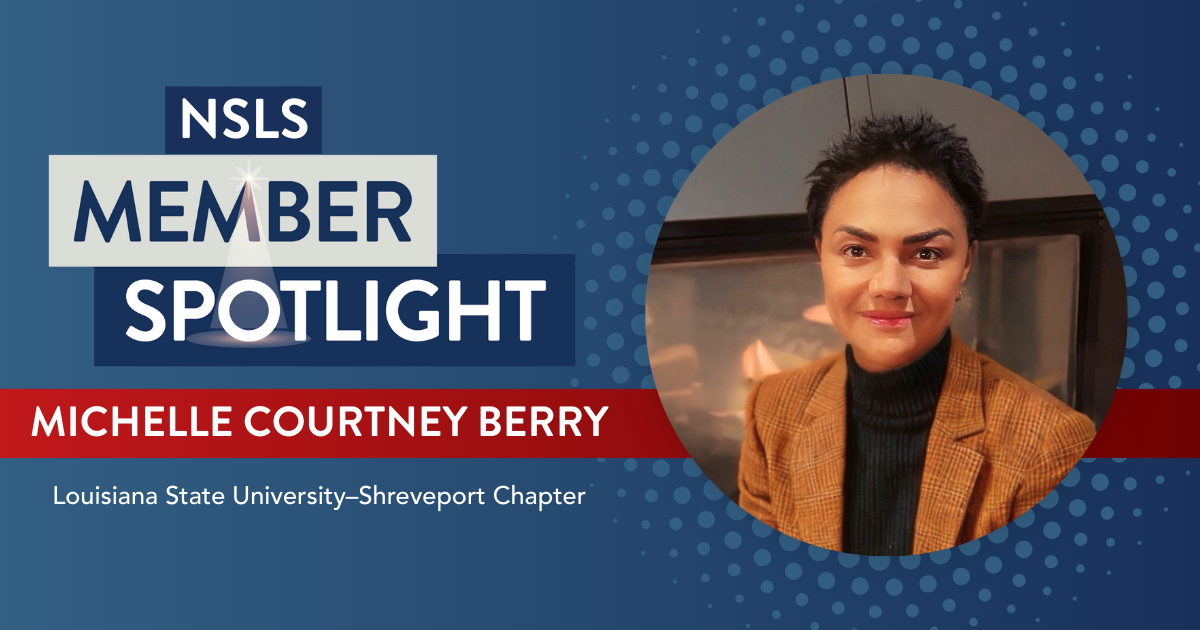
A doctoral candidate in leadership studies at Louisiana State University–Shreveport (LSUS), Michelle Courtney Berry is building a body of work dedicated to turning research into real-world impact.
Slated to graduate in August 2026, Berry’s academic focus centers on servant leadership and its power to transform workplaces into positive spaces, an issue she sees as vital.
“My current research focuses on how servant leadership can reduce the impact of toxic workplace environments,” she says, “which bear tremendous human and financial costs globally… [and] strengthening employee well-being, work that aligns deeply with NSLS’s mission of building ethical, transformational leaders.”
Her work recently earned recognition from LSUS, which featured Berry in an article highlighting both her doctoral research and career achievements. That recognition reflects decades of leadership, coaching, and advocacy focused on employee well-being, ethical organizational culture, and sustainable leadership practices.
Alongside her academic progress, Berry has continued speaking nationally, mentoring leaders at every stage, and launching new stress-reduction training programs, all while balancing the demands of an accelerated doctoral program with professional and community commitments.
As a consultant, coach, and founder of the Workplace Doc™ brand, one thing is certain: Berry is dedicated to helping people find their courage to heal.
Letting Go of Perfection and Leading With Care
Berry notes that growing and achieving her goals took more than just expertise.
“I used a blend of disciplined research skills, strategic communication, emotional intelligence, and adaptive leadership skills to do this work,” she says.
For her school work alone, she leans on skills that will eventually extract concepts into real-world application. “My doctoral research requires rigorous analysis, regular academic writing, and the capacity to distill abstract concepts, such as servant leadership, toxic workplace dynamics, and organizational citizenship behavior, into applicable real-world insights.”
But one of her most meaningful lessons came from learning to release perfectionism.
“I also needed to discover how to put into practice what (I try) to preach, which is to let go of the grip that perfectionism has on me,” she says. “‘Done is better than perfect!’ has become a new mantra.”
That shift reshaped how Berry approaches leadership and personal well-being.
“These lessons cemented for me how important self-care is if I want to be able to care and show up more fully for others,” she says.
As the author of Keeping Calm in Chaos, Berry acknowledges that she often needs to practice what she preaches.
“Whew, have I had to heed my own words and practices,” she says. “I tend to sweat the small stuff, but the big stuff? Either helping clients (or myself) manage a crisis, disaster, or sudden change? I'm all in.”
Leadership Learned Through Service
When asked which leader she most admires, Berry points not to a public figure, but to her 99-year-old Aunt Berta “Bert” Perry.
“A family matriarch and community legend in New Jersey,” Berry says, “[her] life reflects the deepest qualities of moral courage, resilience, and servant leadership.”
Berry describes Perry as a survivor of poverty, segregation, racism, domestic violence, and nearly a century of social change, yet someone who never wavered in her commitment to service.
“She has always led by example, caring for her neighbors, raising several generations, and advocating for those in need,” Berry says.
Berry recalls her aunt demonstrating in her mid-90s against a proposed neighborhood development she believed would cause harm.
“Service has no age limit, nor does courage,” Berry says. “Each day, my Aunt inspires me to lead courageously, with love and compassion, and always with faith and purpose.”
RELATED: LEARNING MINDFULNESS AND BREATHWORK
Scaling Impact and Changing Culture
Berry’s long-term goals reflect her commitment to systemic change.
She plans to continue scaling her Workplace Doc™ practice and research-based model for preventing and remediating toxic workplaces through leadership development and organizational culture change. Alongside completing her doctorate, she aims to expand her scholarship on servant leadership while making her research accessible to leaders and teams.
“I also hope to write more books, focused on business and leadership as well as poetry,” she says, reconnecting with her creative roots as a former poet laureate of her county. “With an eye toward what is true, digestible, and helpful, and distilling what I’ve learned.”
She also envisions collaborative spaces where she can work with others to lift abstract ideas into reality.
“I would welcome a university creating a way to envelop me into a unique Toxic Workplace Environment think-tank where we can put theory to practice,” she says, pointing to World Health Organization estimates that workplace stress could cost the global economy $16 trillion by 2030 if left unaddressed.
Ultimately, Berry says her goal is to utilize all the skills she’s learned to help teams and organizations succeed.
“I am seeking new and better ways to integrate my research, writing, speaking, and coaching in order to help people and organizations thrive,” she says, “and to shift ethical, compassionate, and psychologically safe leadership from a destination to a starting point.”
The NSLS Leadership Framework
Throughout her doctoral journey and professional work, Berry credits the NSLS with helping her lead more intentionally.
“NSLS has made me a better leader because it has equipped me to lead with greater intentionality, accountability, and purpose in every area of my life,” she says.
She notes that tools like SMART goals, Success Networking Teams, and reflective practice provided structure during busy times.
“NSLS challenged me to clarify my values, articulate my mission, and commit to disciplined action, even in seasons of difficulty,” she says. “Implementing NSLS goal setting and accountability strategies has profoundly impacted my academic and community work while fortifying business best practices.”
Those habits now shape how she strives to reach all of her goals.
“Above all, NSLS helped me develop habits of accountability and self-awareness that continue to influence how I mentor others, how I show up in my work, and how I pursue long-term impact,” she says.
Michelle’s Advice for Future Leaders
Berry believes leadership begins within, and from a place of empathy.
“I would advise anyone who wishes to lead and influence others to do so from a place of self-knowing, humility, and authentic care for others,” she says.
She sees leadership as action, not position.
“It is not your title that matters, but how deeply you listen, think before you act, and walk your talk,” she says. “Leadership is a practice, not a place of arrival.”
She encourages future leaders to focus on the well-being of others, and to always be growing.
“People work best when they feel respected, supported, and seen,” she says. “Set clear goals, be accountable to yourself, and commit to continuous learning and growth.”
Above all, Berry returns to the heart of her philosophy: service to others.
“Leadership is service, the daily labor of lifting as you climb and building a kinder, more equitable world.”
Meet Rebekah Opher from the University of Baltimore chapter next to see how servant leadership and compassion drives this law-bound leader to help build a better world.